
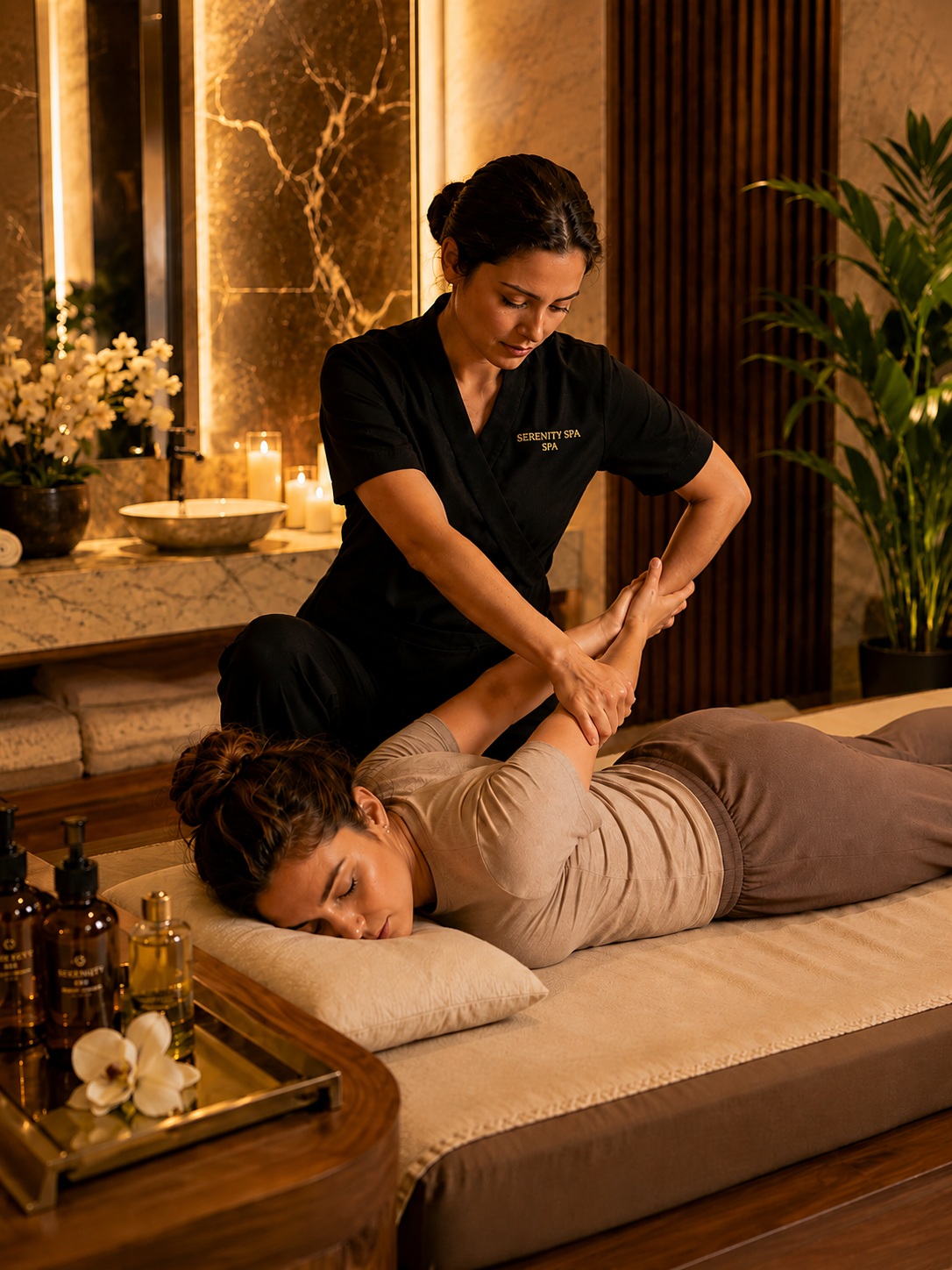
Traditional Thai Massage — The Ancient Bodywork
90 / 120 / 180 minutes | Full body | Clothed, mat-based
Overview
Nuad Boran — literally “ancient massage” — is a healing lineage over two thousand years old, rooted in the sen energy-line theory that underlies traditional Thai medicine. Unlike oil-based massage, nothing here is passive. The therapist moves the guest through assisted stretches, applies rhythmic compression along the body’s energy lines, and works joints through ranges of motion most guests can’t reach alone. It’s often described as “the massage that does the stretching for you” — more physical, more active, and for many guests, more transformative than a purely relaxation-based session.
The Ritual Arc
Phase One — Grounding (5 minutes) Performed on a floor mat rather than a table, in loose, provided clothing that allows full range of motion. The session opens seated, with a few minutes of guided breathing and a brief check on any areas of restriction or old injury before work begins.
Phase Two — Feet & Legs (15–20 minutes) Work begins at the feet, using palm and thumb pressure along the sen lines running up the legs. Compression builds steadily through the calves and thighs, followed by assisted stretches — hip openers, hamstring lengthening — that use the therapist’s own body weight and leverage rather than the guest’s effort.
Phase Three — Hips & Spine (15–20 minutes) The core of the ritual. Rhythmic compression and rocking motions work through the hips and glutes, often the tightest area for guests who sit for long stretches. Spinal twists — some seated, some supine — release tension along the back’s outer lines without direct spinal pressure. This is typically where guests feel the most immediate “unlocking” sensation.
Phase Four — Shoulders, Neck & Arms (15–20 minutes) Compression and stretching move through the shoulders and upper back, followed by traditional Thai arm and hand stretches. Neck work is gentle and largely passive — the therapist guides range of motion rather than applying deep pressure to the cervical spine.
Phase Five — Closing Stretch & Stillness (5–10 minutes) The ritual closes with a full-body assisted stretch — often the most photographed moment of Thai massage, where the guest is guided into a position they couldn’t reach independently — followed by a few minutes of stillness on the mat before sitting up slowly.
What Makes It Work
- Active, not passive. The guest’s body is moved, not just touched — which is why results (particularly mobility) are often felt immediately, not just the next day.
- Assisted, never forced. Every stretch uses the therapist’s leverage and the guest’s own breath; nothing is pushed past a comfortable range.
- Energy-line logic, not muscle-group logic. Compression follows the sen lines rather than isolated muscles, which is why guests often feel effects in areas the therapist never directly touched.
Benefits
- Deep release through hips, shoulders, and spine
- Meaningful improvement in joint mobility and range of motion
- Effective for chronic tightness that oil-based massage alone doesn’t reach
- Improved circulation and lymphatic flow from compression work
- A distinct, clear-headed alertness afterward — different from the sleepiness of aromatherapy massage